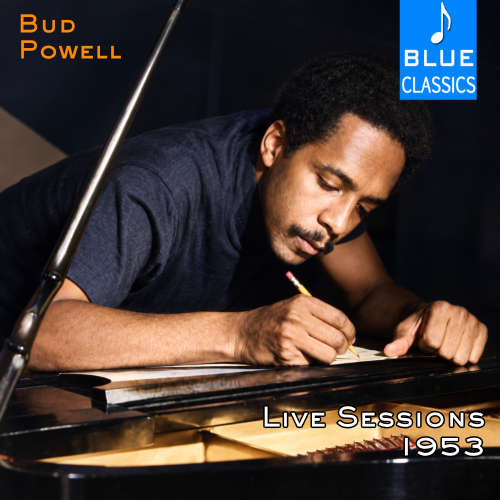
Title: LIVE SESSIONS 1953
Year: 1953
Category: JAZZ,PIANO,BLUECLASSICS
- 1. Tea for Two 05:36
- 2. It Could Happen to You 03:31
- 3. Lover Come Back to Me 06:56
- 4. Lullaby of Birdland 02:52
- 5. I've Got You under My Skin 02:41
- 6. Ornithology 02:59
- 7. Budo 02:04
- 8. Sure Thing 02:01
- 9. Woody'n You 02:54
- 10. Salt Peanuts 04:16
- 11. (Jubilee) Hallelujah 03:53
- 12. Embraceable You 04:21
- 13. Cherokee 04:49
- 14. My Devotion 02:34
- 15. Autumn in New York 02:10
- 16. I Want to Be Happy 04:19
- 17. Moose the Mooche 05:00
- 18. Cheryl 07:02
- 19. My Heart Stood Still 03:01
- 20. Dance of the Infidels 04:04
- 21. Un Poco Loco 04:19
- 22. Glass Enclosure 02:22
- 23. Oblivion 02:30
- 24. Parisian Thoroughfare 03:52
- Bud Powell – piano
Tracks 1–3:
Recorded at Birdland, New York City, February 7, 1953
WJZ radio broadcast
Oscar Pettiford – bass
Roy Haynes – drums
Tracks 4–6:
Recorded at Birdland, New York City, February 14, 1953
WJZ radio broadcast
Oscar Pettiford – bass
Roy Haynes – drums
Track 7:
Recorded at Birdland, New York City, March 7, 1953
WJZ radio broadcast
Franklin Skeete – bass
Sonny Payne – drums
Tracks 8–10:
Recorded at Birdland, New York City, March 21, 1953
WJZ radio broadcast
Charles Mingus – bass
Roy Haynes – drums
Tracks 11–13:
Recorded at Massey Hall, Toronto, Canada, May 15, 1953
Charles Mingus – bass
Max Roach – drums
Track 14:
Recorded in New York City, September 1953
Roost studio session
George Duvivier – bass
Art Taylor – drums
Tracks 15-16:
Recorded at Birdland, New York City, May 30, 1953
WJZ radio broadcast
Charles Mingus – bass
Art Taylor – drums
Tracks 17-18:
Recorded at Birdland, New York City, May 30, 1953
WJZ radio broadcast
Charlie Parker – alto sax
Charles Mingus – bass
Art Taylor – drums
Candido – congas
Tracks 19-20:
Recorded at Birdland, New York City, June 20, 1953
WJZ radio broadcast
George Duvivier – bass
Art Taylor – drums
Tracks 21-22:
Recorded at Birdland, New York City, September 5, 1953
WJZ radio broadcast
George Duvivier – bass
Art Taylor – drums
Tracks 23:
Recorded at Birdland, New York City, September 19, 1953
WJZ radio broadcast
Curly Russell – bass
Art Taylor – drums
Tracks 24:
Recorded at Birdland, New York City, September 26, 1953
WJZ radio broadcast
Curly Russell – bass
Art Taylor – drums

LIVE SESSIONS 1953
by Bud Powell with Charles Mingus, Roy Haynes
The year 1953 was one of the most active and musically important years of Bud Powell's career. It was also a complicated period in his personal life. The recordings made during the year document a pianist who, despite severe difficulties in the preceding years, could still produce performances of extraordinary technical command, harmonic imagination and rhythmic intensity.
Powell had already established himself as one of the central architects of bebop. His piano playing had transformed the role of the instrument within the new music: rapid melodic lines, sophisticated harmonic substitutions and a highly linear approach allowed the pianist to function almost like a horn player, while his left hand provided a remarkably economical harmonic foundation. His influence on subsequent generations of jazz pianists was already profound.
But the early 1950s had been extremely difficult for Powell. After serious physical and psychological problems, hospitalizations and periods away from the New York jazz scene, he remained under legal guardianship in 1953. Oscar Goodstein, the owner and manager of Birdland, became responsible for managing Powell's affairs and arranged an extended engagement for him at the club. According to the documentation accompanying the Birdland 1953 recordings, Goodstein booked Powell for twenty weeks at Birdland. The regular work gave Powell an opportunity to play consistently again and to rebuild some of the technical command that had been affected by his earlier hospitalizations.
The first surviving broadcasts from the year come from Birdland on February 7 and 14. Powell was accompanied by bassist Oscar Pettiford and drummer Roy Haynes. The performances show him working through a repertoire of standards and bebop material with remarkable fluency. Tea for Two and It Could Happen to You immediately demonstrate the speed and precision of his improvisational language, while the February 14 performances of Embraceable You, I've Got You Under My Skin and Ornithology reveal an equally strong ability to shape a melody through harmony and phrasing.
Powell continued broadcasting from Birdland throughout the spring. On March 7, he was heard with bassist Franklin Skeete and drummer Sonny Payne. Two weeks later, on March 21, he performed with Charles Mingus and Roy Haynes. The latter broadcast contains Sure Thing, Woody'n You and Salt Peanuts, showing Powell at the centre of the rapidly developing bebop language while also demonstrating his ability to make familiar repertoire sound completely personal.
The spring culminated in one of the best-known concerts in jazz history. On May 15, 1953, Powell joined Charlie Parker, Dizzy Gillespie, Charles Mingus and Max Roach at Massey Hall in Toronto. The concert has become known as Jazz at Massey Hall, and the Powell Trio portion of the program is especially valuable because it places his piano playing in an intimate setting with Mingus and Roach. The trio performed Cherokee, Embraceable You, Jubilee (Hallelujah), Sure Thing, Lullaby of Birdland and I've Got You Under My Skin.
The Toronto concert also provides an important reminder of the breadth of the musical world surrounding Powell. Max Roach performed a drum solo, Drum Conversation, while a separate recording titled Bass-ically Speaking from the same broad Debut project was actually made in New York with Billy Taylor, Charles Mingus and Art Taylor, rather than with Powell.
Powell's musical relationship with Charlie Parker was also renewed during this period. On May 30, a Birdland broadcast featured Parker with Powell, Mingus, Art Taylor and the Cuban percussionist Candido. Moose the Mooche and Cheryl, both Parker compositions, preserve the two bebop pioneers together in a setting that reflects the close musical connection between Parker's saxophone and Powell's piano.
By June, Powell was performing with George Duvivier and Art Taylor. The June 20 Birdland broadcast includes Budo, My Heart Stood Still and Dance of the Infidels. Powell's original compositions are particularly revealing here. His pieces did not simply provide vehicles for improvisation; they were carefully constructed frameworks in which his harmonic imagination and characteristic melodic language were already embedded.
The summer also brought important studio work. On August 14, 1953, Powell recorded for Blue Note at WOR Studios in New York, again with George Duvivier and Art Taylor. The session produced such important Powell compositions as Sure Thing and The Glass Enclosure, together with Autumn in New York, I Want to Be Happy, Polka Dots and Moonbeams and other material. These recordings were subsequently issued on The Amazing Bud Powell, Volume 2.
The Glass Enclosure is among the most striking compositions associated with this period. Its title and atmosphere have frequently been discussed in connection with Powell's difficult circumstances, although interpretations of the precise inspiration behind the piece differ. What is unmistakable in the music itself is its tension: the composition combines sharply defined melodic material with a sense of harmonic confinement and release. Powell's personal circumstances and his musical imagination were inseparable parts of the world from which such music emerged.
During September, Powell returned to Birdland, where a series of WJZ broadcasts documents his playing with Art Taylor and two different bassists. On September 5, George Duvivier was the bassist; on September 19 and September 26, the bassist was Curly Russell. The September performances include several of Powell's most important compositions: Un Poco Loco, Dance of the Infidels, Glass Enclosure, Oblivion and Parisian Thoroughfare.
These autumn performances are particularly valuable because they show how Powell's music could function in a live environment over an extended period. Un Poco Loco is perhaps the clearest example of his ability to construct a composition whose unusual harmonic and rhythmic character becomes a springboard for improvisation. The piece had already been recorded by Powell in the studio in 1951, but the later performances show how naturally its compact musical structure could expand in concert. The composition is documented as a Powell work published by Patricia Music Publishing Corp.
The same is true of Dance of the Infidels, another Powell composition whose melodic and harmonic construction became part of the modern jazz repertoire. Its later performances reveal the extent to which Powell could maintain the architecture of a composition while simultaneously pushing the improvisation toward great rhythmic and harmonic freedom. Current catalog metadata identifies EMI Longitude Music as publisher.
Although 1953 brought Powell an unusually large amount of performing and broadcasting activity, his personal difficulties did not disappear. Accounts of the period describe continuing problems with alcohol and medication, as well as increasing withdrawal and changes in his behaviour. Later interpretations of his medical history have differed, and retrospective diagnoses should therefore be treated cautiously. What can be established is that his health remained a serious problem while he was simultaneously maintaining a demanding schedule of performances and recordings.
The surviving music from 1953 nevertheless presents a remarkably coherent picture of Powell as an artist. Whether playing standards such as Tea for Two, Embraceable You and Autumn in New York, bebop compositions such as Parker's Ornithology and Moose the Mooche, or his own works including Budo, Un Poco Loco, Dance of the Infidels and Parisian Thoroughfare, Powell consistently approached the piano with an extraordinary combination of precision and freedom.
His technique was not an end in itself. The extraordinary speed of his right hand, the economy of his left-hand voicings and the density of his harmonic ideas were all placed at the service of melodic invention. At his best, Powell could make even the most complicated harmonic passage sound inevitable. The music moves with the force of bebop, yet it is structured with an almost classical sense of proportion.
The recordings of 1953 therefore occupy a crucial position in Powell's recorded legacy. They document him in clubs, on radio broadcasts, at Massey Hall and in the recording studio, working with a remarkable range of musicians: Oscar Pettiford, Roy Haynes, Franklin Skeete, Sonny Payne, Charles Mingus, Max Roach, George Duvivier, Art Taylor and, in the Birdland broadcasts, Charlie Parker and Candido. The result is a portrait of Powell not as a musician confined to one celebrated trio or one particular recording session, but as an active New York pianist whose music continued to develop under extraordinarily difficult circumstances.
In 1953, Bud Powell was only twenty-nine years old. His health remained fragile and his personal life unstable, but his musical voice was already fully formed. The recordings from that year show a pianist whose conception of bebop had become both highly individual and remarkably durable — a language of speed, clarity, harmonic sophistication and melodic invention that would continue to influence jazz long after the circumstances in which it was created had disappeared.